JMIR Publications
Newsroom
Posts about:
Blog (3)
The Power of a Combined Approach: Transforming Youth Mental Health
Mental health concerns are a leading cause of mortality for young people, making timely, high-quality, and affordable care a top priority. In Australia, however, the growth of youth mental health services has slowed, creating a critical gap between rising demand and available resources. Can digital solutions help close this gap?
Redefining Nursing with Large Language Models
For a field as hands-on and human-centered as nursing, artificial intelligence (AI), particularly large language models (LLMs), present both a huge opportunity and a complex challenge. While LLMs are rapidly entering nursing classrooms, their fundamental concepts remain largely unexplored.
The Powerful Purpose of Peer Reviewers
Peer review is the bedrock of scientific publishing. It’s the essential process that ensures research is rigorous, ethical, and trustworthy before it reaches the wider world. While this process is often unseen, it’s driven by the dedication and hard work of thousands of volunteers.
During Peer Review Week 2025, we’re taking a moment to celebrate our incredible, real life, JMIR peer reviewers. They are at the heart of our mission to advance digital health research. We asked them to share their experiences and insights, and their reflections offer a powerful look into why they choose to give their time and expertise.
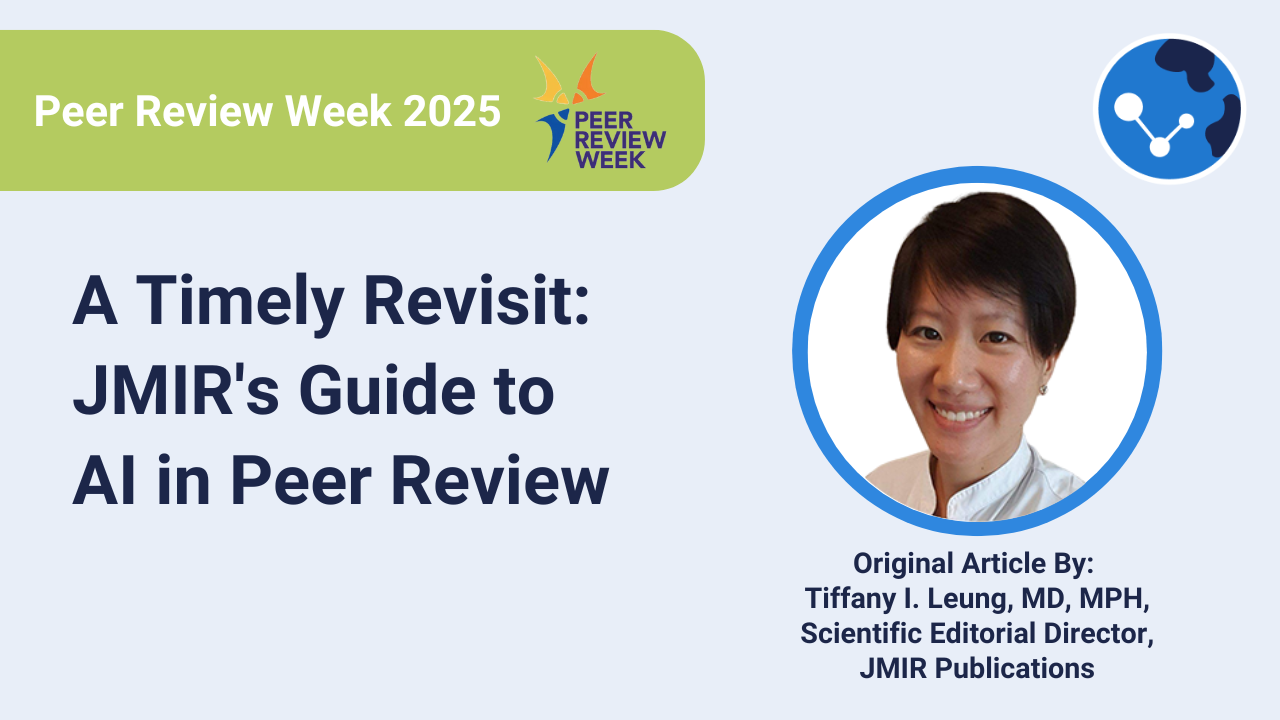
A Timely Revisit: JMIR's Guide to AI in Peer Review
This Peer Review Week, we're doing something a little different. As the global theme, “Rethinking Peer Review in the AI Era,” takes center stage, we’ve decided to bring back a piece of content that is more relevant now than ever.
Last year, we published an insightful guide on the ethical integration of AI into the peer review process. This guide was born from the recognition that AI was not a future possibility, but a present reality. Today, as the conversation has shifted from "if" to "how" AI should be used, our guidance remains a crucial resource.
Below is our 2024 blog post, "Navigating the Intersection of AI and Peer Review: A Guide for Ethical Integration," reproduced in full. We invite you to read it again—or for the first time—and join us in the ongoing dialogue about how to harness the power of AI while upholding the integrity and human spirit of scholarly evaluation.
Bridging the Digital Divide for Older Adults
Technology is an increasingly critical part of mental health care - but does it empower or exclude older adults? This is a growing concern, as this population often faces unique physical and psychosocial challenges, as well as barriersin accessing advanced technology.
Prior Authorization: A Hidden Influence on Provider Behavior
For many patients, getting a prescription for a new medication often involves an extra step for their doctor: prior authorization (PA). This process, required by insurance companies, is intended to ensure safety and quality control. However, it can also create significant delays, contributing to provider frustration and, in some cases, negatively impacting patient care.
Q&A with Mike Byer, Our New Institutional Partnerships Lead
We are excited to introduce Mike Byer, our new Institutional Partnerships Lead dedicated to supporting university librarians. To help you get to know them better, we've prepared a Q&A session covering their background, goals, and how they plan to collaborate with the community.
Tailoring Mental Health Support for Ukrainian Refugees
Digital technology has become a lifeline for mental health support, offering accessible and affordable solutions for people who might otherwise have no access to care. However, simply creating a great digital platform isn't enough - you need people to use and engage with it. Without high adherence, even the most effective tool can't help those who need it most. This is particularly true for vulnerable and underserved populations, such as the millions of Ukrainian refugees displaced in the ongoing humanitarian crisis.
Unlocking a Clearer Picture of Youth Mental Health
Promoting the mental well-being of young people is a top priority for municipalities in Sweden and around the world. It’s seen as one of the most effective ways to ensure a high quality of life for future generations and manage healthcare costs. However, mental well-being is influenced by a complex web of factors, and different municipal departments often collect different kinds of data, making it difficult to get a complete picture.