JMIR Publications

Newsroom

Posts about:

Peer Review

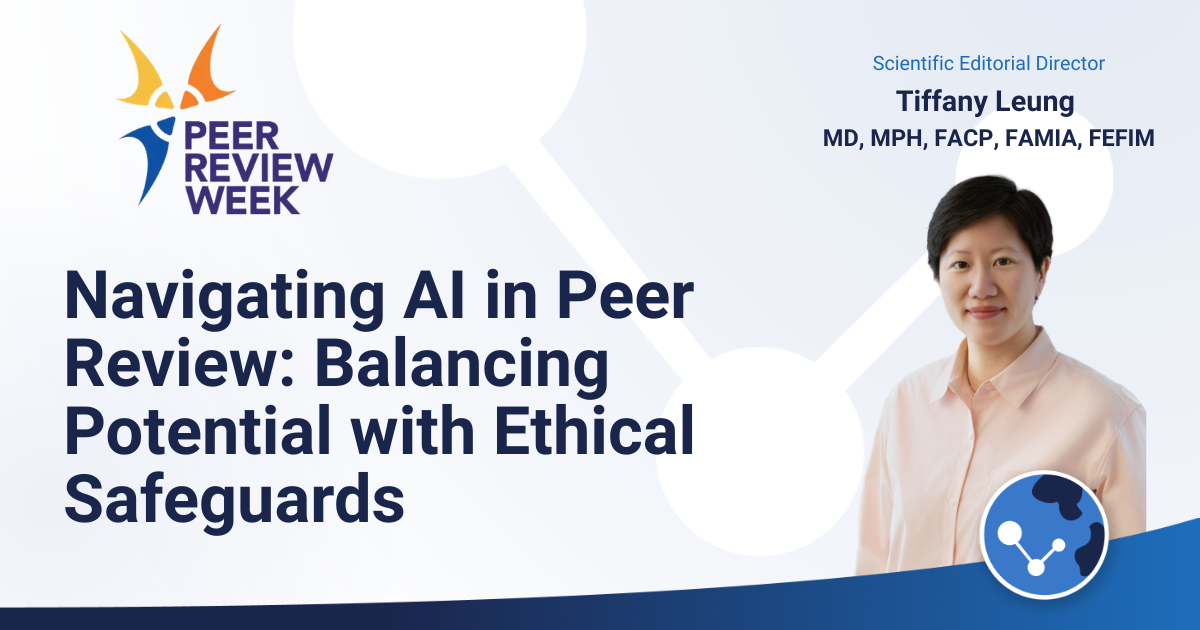
Peer review week blog header featuring photo of Tiffany Leung

Navigating AI in Peer Review: Balancing Potential with Ethical Safeguards


Ask any peer reviewer or editor what's changed most about their workload in the last two years, and generative artificial intelligence (AI) is likely to come up quickly in conversation. Peer reviewers might identify AI tools as something they've started using for extra review help, or they’re thinking about whether to do this and how to do it ethically. Editors will say they’re seeing more and more formulaic-appearing peer reviews that look suspiciously like they are AI-generated. Authors also are noticing this in peer reviews too. 

Read More

Why AI Disclosure by Authors Still Matters for Capacity, Speed, and Quality


Generative artificial intelligence (AI) tools can genuinely help researchers organize, conduct, and write up their research work faster than ever before. However, a lack of transparency on how these tools were applied and their outputs verified can influence scientific work and its trustworthiness. 

Read More

Early Lessons from JMIR's Karma Reviewer Rewards Program


Why does anyone agree to review a manuscript at all? It's unpaid, mostly invisible work, on top of a reviewer's own research and clinical or academic responsibilities. Yet the entire scholarly publishing system depends on people saying yes. I work on peer review operations and editorial policy at JMIR Publications, and this is the question I keep coming back to.

Read More

Honoring the Effort: JMIR Publications Peer Review Recognition Program


Peer review is the heartbeat of scholarly publishing. It requires countless unseen hours of critical reading, deep intellectual effort, and constructive feedback to ensure published research is rigorous, accurate, and trustworthy. Yet, despite being essential to scientific progress, the dedicated effort behind peer review often goes unacknowledged.

Read More

Demystifying Peer Review: 3 Things You Should Know


Sustaining peer review capacity amid rising submission volumes requires balancing three core elements: speed, quality, and expanding the reviewer workforce. By treating reviewer feedback as a collaborative editing process rather than a barrier, incorporating vetted early-career researchers into the reviewer pool, and utilizing transparent review models, the scientific community can drastically reduce publication bottlenecks without compromising integrity.

Read More
5 Publishing Roadblocks (and How to Fix Them) featuring a picture of Jane Kelly

5 Publishing Roadblocks (and How to Fix Them)

Struggling with a tough submission? Before you withdraw your manuscript and set your publishing timeline back by six months, let’s find a solution together. At JMIR Publications, we have built-in pathways to solve your biggest publishing roadblocks: we offer flexible funding alternatives (like our low-cost JMIRx journals), fast-track reviews to meet urgent career deadlines, editor-mediated support to help you appeal harsh reviewer comments, seamless sister-journal transfers to preserve your peer-review progress, and straightforward ways to correct post-submission data errors.

Read More
The Powerful Purpose of Peer Reviewers: Giving Back, Gaining More

The Powerful Purpose of Peer Reviewers

Peer review is the bedrock of scientific publishing. It’s the essential process that ensures research is rigorous, ethical, and trustworthy before it reaches the wider world. While this process is often unseen, it’s driven by the dedication and hard work of thousands of volunteers.

During Peer Review Week 2025, we’re taking a moment to celebrate our incredible, real life, JMIR peer reviewers. They are at the heart of our mission to advance digital health research. We asked them to share their experiences and insights, and their reflections offer a powerful look into why they choose to give their time and expertise.

Read More