
Metrics as a Byproduct: Inside JMIR Publications’ Latest JCR Success
.jpeg?width=45&name=Image%20(5).jpeg)
Published Date: 28 July 2026 9:45 a.m.

Every June, the scholarly publishing ecosystem undergoes a familiar ritual. Inboxes and industry feeds flood with identical, celebratory corporate press releases as Clarivate drops the latest Journal Citation Reports (JCR). But for publishing executives navigating a market defined by massive commercial consolidation, the real value of these metrics lies beneath the surface. The true strategic question isn't "Did our scores go up?" but rather, "What do these metrics tell us about the structural shift in where researchers want to publish?"
| Key Takeaways |
| Niche Portfolios Outperform Scale: Agile, highly specialized journals achieve greater success than broad-scope mega-journals by providing immediate community relevance and rapid speed-to-market in complex, technical fields. |
| Metrics as a Byproduct of Integrity: High JIF and CiteScore results are a natural outcome of systemic editorial integrity, not a marketing goal. Practices like transparent peer review and open data sharing facilitate these results organically. |
| The Competitive Advantage of Independence: Independent, mission-driven publishers maintain a resilient market position against massive commercial aggregators by uniquely combining technical agility with deep, specialized domain expertise. |
The prevailing industry strategy for open access (OA) growth prioritized the mega-journal; broad-scope venues built to capture massive article volumes. However, a look at the latest performance data reveals an alternative. Agile, highly specialized, niche portfolios are proving that precision and deep domain alignment can outpace sheer scale.
The Power of Micro-Domain Acceleration
When an independent, digital-native publisher competes in highly niche spaces, success depends on speed to market and immediate community relevance. Legacy models often spend years moving a new sub-discipline through internal governance before launching a title. Fully OA publishers are structured to move much faster, capturing early, high-impact citations before category boundaries are set in stone.
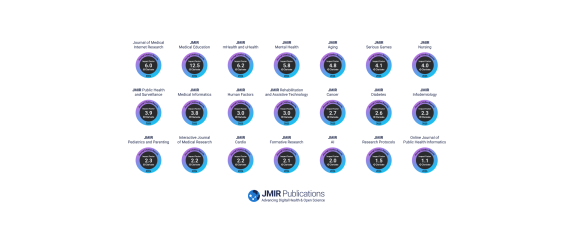
The recent JCR release serves as a prime case study for this framework. Consider the trajectory of JMIR AI. Over a single metric cycle, the journal climbed from Q3 to Q1 status, jumping to an impressive 6.1 Journal Impact Factor (JIF). By launching a highly specialized venue exactly when the conversation around clinical machine learning exploded, the portfolio captured foundational science early.
Similarly, specialized positioning allows smaller titles to completely dominate established niches. JMIR Medical Education secured the absolute #1 spot in the Education, Scientific Disciplines category with an outstanding 13.9 JIF. When a single-domain journal outperforms massive general-interest legacy titles, it signals that researchers value hyper-focused communities over broad, multi-disciplinary catch-alls. Across the JMIR portfolio, 12 separate journals secured coveted Q1 rankings this year, reinforcing that quality can be replicated systematically across distinct niches.
The Integrity Multiplier: Balancing DORA with Metric Health
How does a publisher celebrate portfolio-wide metric growth while remaining a strict, active signatory of DORA (the San Francisco Declaration on Research Assessment)? The answer is treating metrics as a lagging indicator rather than a primary goal. Chasing impact metrics through artificial portfolio inflation is a short-term game that introduces significant risk to research integrity. Conversely, embedding modern, open-science infrastructure - robust peer review, dedicated research integrity teams, automated PID and metadata sharing, oversight of PhD-level scientific editors, and professional copy editing - directly into the workflow yields high metrics organically.
When a publisher actively lowers the friction of dissemination the science itself becomes inherently more discoverable, verifiable, and usable. Rigorous science that is easy to find and trust naturally generates citations. High JIF and CiteScore results shouldn’t be viewed as marketing clout; they are a direct byproduct of systemic editorial integrity.
The Independent Road Ahead
The ongoing consolidation in scholarly publishing shows no signs of slowing down, but the market share for independent mission-driven publishing remains incredibly resilient. The future of scholarly communication doesn’t belong exclusively to the largest aggregators. There is a thriving, highly influential space reserved for independent fully open access publishers who combine technical agility with domain expertise.
Editor's Note: Data cited in this piece is drawn from the recent Clarivate Journal Citation Reports release. For the complete breakdown of portfolio performance metrics across the digital health and open science landscape, visit the JMIR Publications Official Announcement Channel.
.png)
