

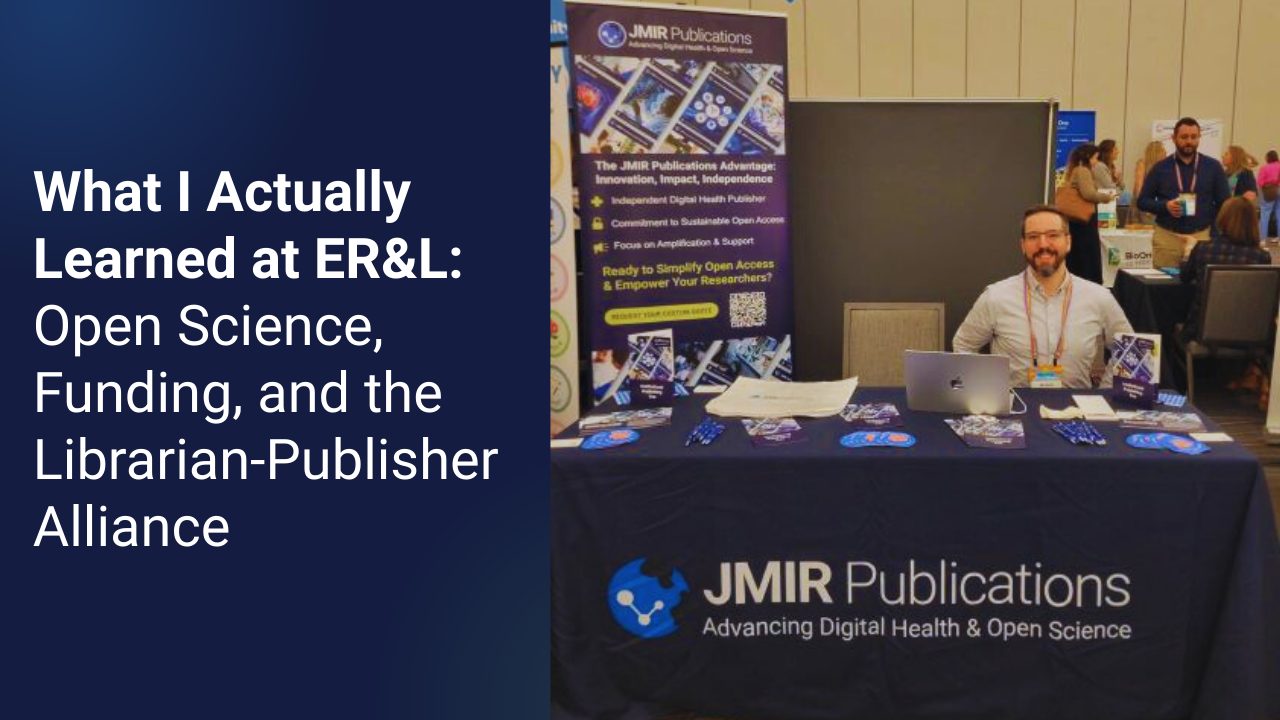
I had a great time in Austin at the ER&L Fest. The longer I’m in the position of Institutional Partnerships Lead at JMIR, the more I enjoy working with librarians. As a group, they are friendly, thoughtful, and ask great questions. This shouldn’t come as a surprise to me - my mother was a public librarian and I spent many, many hours among the book stacks of her workplaces.
ER&L Blog: Key Takeaways
| The Accelerating Shift to Open Science: Research is moving toward a public-access only model, and it's happening fast. |
| Addressing Library Financial Constraints: Institutions want to stop paying for "reading" and "publishing" in one giant, confusing lump sum. |
| Librarian-Publisher Alliance: Libraries and publishers are teaming up on a new flat-fee model. |
In my planning for ER&L I wrote a blog with a series of questions that I hoped to have answered at the conference. I didn’t get full clarity about all of those questions, but I learned quite a bit.
These are my three observations from ER&L 2026:
-
The Open Science future is arriving quickly. Almost everyone I spoke to, regardless of their role, said that Open Access was a major topic of discussion on their campus. Researchers are asking how the library can help them meet their funding mandates. More librarians have Open Access as a regular part of their responsibilities. Several people in leadership positions said they are actively surveying for agreements to grow OA publishing opportunities beyond the big Read and Publish deals.
-
Librarians and independent OA publishers are natural allies. Restricting access to information is antithetical to both groups. There was a lot of nodding as I talked about how our Institutional Publishing Fee can improve equity and protect academic freedom by removing APCs for their researchers. There was more nodding when I said our IPF provides unlimited publishing and will not require them to actively track publications and deliver the bad news of a capped-out deal to eager researchers. Finally, there were a lot of surprised smiles when I described how any remaining funds at the end of a deal term will just be rolled over to reduce the renewal fee.
-
Budgets are the biggest impediment to progress but there are plans to fix that. Many institutional libraries are facing serious financial constraints this year and into the future. This means they may be unable to pursue new publishing agreements right now, but they are building them into their longer-term plans. A common theme I heard was a particular interest in institutional funding for health research publishing, especially when it supports research involving AI applications, which is JMIR’s niche.
Along with reduced or flat funding, the structure of budgets also limit opportunities to pursue new deal formats. Currently, OA funding is part of the content aquisition budget through Read & Publish deals. Splitting that budget into separate Read and Publish categories will allow libraries to distribute their publishing support more equitably. I received a lot of support for this idea, but that kind of change will take time.
.png?width=250&height=250&name=ERL%20sticker%20(2).png)
-
Bonus Observation: Librarians are drawn to whimsy. So many people were delighted by our new stickers. Do you want a sticker of your own? Show your support for open science and claim your exclusive Open Access Powers Discovery Sticker! Simply share your mailing address with us so we can send this token of appreciation your way. We’re thrilled to celebrate our community of open access advocates—thank you for helping us make knowledge accessible to all!
Thank you to everyone who stopped by the JMIR booth in Austin. I look forward to working with so many of you to deliver on the promise of Open Science.

.png)
.png)
