

.png)
June is Alzheimer’s & Brain Awareness Month, a dedicated time to focus on our cognitive well-being. As part of our special coverage for this awareness month, JMIR Publications is hosting a blog series highlighting how proactive strategies and supportive environments can drastically improve the trajectory of cognitive decline. In this installment, we shift our focus to everyday digital tools and explore how mobile applications, conversational AI, and pocket-sized chatbots are finding a home in daily dementia management to support both patients and caregivers.
Key Takeaways |
| Speech Over Touch: Conversational AI and talking avatars offer a more natural, accessible interface for older adults experiencing cognitive decline compared to traditional touchscreen menus. |
| Personalization Drives Adoption: When digital health tools are tailored to an individual's specific cultural background, daily routines, and lifestyle, user compliance and retention rates increase significantly. |
| Measurable At-Home Benefits: Structured mobile assistive technologies can directly improve a patient's independence with activities of daily living (ADLs), which in turn helps reduce overall caregiver burnout. |
When we think about managing progressive memory loss or Alzheimer's disease, we often think of traditional clinical environments. However, a significant portion of care happens at home during daily routines like getting dressed, keeping appointments, or just sharing a friendly conversation.
Two recent studies published in JMIR Aging show how mobile apps and conversational AI are stepping into home care settings to offer structured, real-time assistance.
1. Talking it Out: Can Voice-Enabled Virtual Assistants Support Memory?
For older adults navigating amnesia or early-stage dementia, navigating a smartphone touchscreen by pushing buttons can become increasingly frustrating as cognitive decline progresses. Verbal communication, by contrast, remains a natural and deeply ingrained habit.
A systematic review conducted by Roel Boumans, MSc, PhD, Yana van de Sande, BSc, Serge Thill, PhD, and Tibor Bosse, PhD at Radboud University in the Netherlands explored the potential of Intelligent Virtual Agents (IVAs), talking digital characters displayed on a screen, to act as verbal coaches for adults with memory problems. Their analysis revealed three key insights into how these virtual agents are transforming daily support:
-
Natural Interactions: By analyzing experimental data across multiple studies, the researchers found that older adults generally maintain a highly positive attitude toward talking digital avatars. Talking requires less technical literacy than standard smartphone menus, making it an inviting interface for long-term use.
-
Consistent Usability Trends: Across the analyzed literature, usability scores leaned consistently positive. For instance, in studies evaluating conversational skills, participants scored systems highly for ease of use and friendliness.
- Current Limitations & Future Directions: The authors noted that current conversational technology in this space is still in its infancy, often relying on brief dialogues and predetermined phrases. To unlock the full potential of IVAs, future research must focus on building more complex, prolonged, and fluid conversational capabilities to keep users engaged and supported 24/7.
2. Mapping Habits: Personalized Visual Apps for Daily Tasks
While virtual agents focus on conversation, another side of mobile health (mHealth) focuses on structural independence. As memory declines, breaking down the exact sequence of steps required for Activities of Daily Living (ADLs), such as bathing, brushing teeth, or dressing, becomes a major hurdle.
A feasibility study from a research team at Emory University in Georgia evaluated MapHabit, an mHealth app accessed via tablets that provides step-by-step visual map templates integrated with keywords to guide users through daily care steps.
-
The Demographic Focus: The researchers tested the app across two distinct clinical cohorts: 14 individuals from a Department of Veterans Affairs (VA) clinic (100% male; 71.4% Black) and 8 individuals from a non-VA clinic (62.5% male; 100% Black).
-
Perceived Daily Improvements: After 3 months of using the visual maps, both groups experienced notable quality-of-life adjustments. The VA participants reported significant perceived improvements in social engagement and the performance of daily tasks. The non-VA participants saw an even broader impact, reporting improvements in daily tasks, overall mood, social engagement, and personal memory.
A Broad Appeal: Technology adoption was remarkably high, defying the stereotype that older adults reject digital intervention. Ultimately, 93% of the VA participants and 100% of the non-VA participants completed the study, with every single participant stating they would recommend the visual mapping system to a colleague.
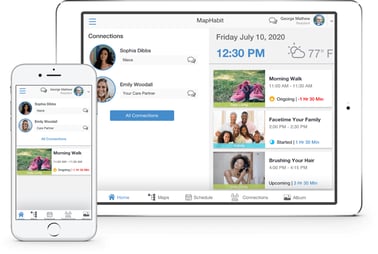
| Screenshots of the MapHabit system app on mobile and tablet devices. |
Empowering Home Care: Where Conversation Meets Structure
Together, these two studies highlight how multifaceted digital health interventions must be to truly transform home care for dementia. While the Radboud University review demonstrates that voice-enabled virtual agents provide a natural, accessible communication interface, the Emory University study shows how structured visual mapping through apps like MapHabit provides the necessary cognitive scaffolding for daily tasks. By pairing the intuitive ease of speech with personalized, step-by-step visual routines, these innovations move digital care out of the clinical environment and straight into the home—ultimately preserving patient independence, lowering the barrier to technology adoption, and providing much-needed relief for family caregivers.
Check back soon for the next installment of our Alzheimer’s & Brain Awareness Month series, where we dive into how interactive online toolkits are empowering care partners with critical e-learning and digital psychoeducation.
Please cite as:
Boumans R, van de Sande Y, Thill S, Bosse T. Voice-Enabled Intelligent Virtual Agents for People With Amnesia: Systematic Review. JMIR Aging 2022;5(2):e32473
URL: https://aging.jmir.org/2022/2/e32473
DOI: 10.2196/32473
Kelleher J, Zola S, Cui X, Chen S, Gerber C, Parker M, Davis C, Law S, Golden M, Vaughan C. Personalized Visual Mapping Assistive Technology to Improve Functional Ability in Persons With Dementia: Feasibility Cohort Study. JMIR Aging 2021;4(4):e28165
URL: https://aging.jmir.org/2021/4/e28165
DOI: 10.2196/28165
.png)