---
title: JMIR Publications Blog | Artificial Intelligence
description: Artificial Intelligence | Blog posts, white papers and rich media content dedicated to researchers, authors, librarians, institutions, funders in academic and scholarly publishing
---
[](http://www.jmirpublications.com)
Open main menu Close main menu
# JMIR Publications
# Newsroom
Select Category Aging Artificial Intelligence Digital Psychiatry Early Career Researcher Events Industry News JMIR News Libraries Open Access Peer Review Research News Women in Science
Posts about:
## Artificial Intelligence

[Research News,](https://blog.jmir.org/tag/research-news) [Artificial Intelligence](https://blog.jmir.org/tag/artificial-intelligence)
### [Beyond Prediction: Bertalan Meskó on Shaping the Future of Medicine](https://blog.jmir.org/beyond-prediction-bertalan-meskó-on-shaping-the-future-of-medicine)
15 October 2026 10:43 a.m.
How can healthcare move beyond reacting to change and start preparing for what’s next? In this interview, [Dr. Bertalan Meskó, MD, PhD](https://www.linkedin.com/in/bertalanmesko/), guest editor of the *[Journal of Medical Internet Research](https://www.jmir.org/)* theme issue “[The Emergence of Medical Futures Studies](https://www.jmir.org/themes/1638/2026-theme-issue-2024-the-emergence-of-medical-futures-studies),” shares how futures methods can help shape a more intentional future for medicine.

[Isabella Hernandez](https://blog.jmir.org/author/isabella-hernandez)
[Read More](https://blog.jmir.org/beyond-prediction-bertalan-meskó-on-shaping-the-future-of-medicine)
[Peer Review,](https://blog.jmir.org/tag/peer-review) [Artificial Intelligence](https://blog.jmir.org/tag/artificial-intelligence)
### [Navigating AI in Peer Review: Balancing Potential with Ethical Safeguards](https://blog.jmir.org/navigating-ai-in-peer-review-balancing-potential-with-ethical-safeguards)
13 September 2026 11:37 a.m.
---
Ask any peer reviewer or editor what's changed most about their workload in the last two years, and generative artificial intelligence (AI) is likely to come up quickly in conversation. Peer reviewers might identify AI tools as something they've started using for extra review help, or they’re thinking about whether to do this and how to do it ethically. Editors will say they’re seeing more and more formulaic-appearing peer reviews that look suspiciously like they are AI-generated. Authors also are noticing this in peer reviews too.

[Tiffany I. Leung, MD, MPH, FACP, FAMIA, FEFIM](https://blog.jmir.org/author/tiffany-i-leung-md-mph-facp-famia-fefim)
[Read More](https://blog.jmir.org/navigating-ai-in-peer-review-balancing-potential-with-ethical-safeguards)
[Peer Review,](https://blog.jmir.org/tag/peer-review) [Artificial Intelligence](https://blog.jmir.org/tag/artificial-intelligence)
### [Why AI Disclosure by Authors Still Matters for Capacity, Speed, and Quality](https://blog.jmir.org/why-ai-disclosure-by-authors-still-matters-for-capacity-speed-and-quality)
13 September 2026 11:33 a.m.
---
Generative artificial intelligence (AI) tools can genuinely help researchers organize, conduct, and write up their research work faster than ever before. However, a lack of transparency on how these tools were applied and their outputs verified can influence scientific work and its trustworthiness.

[Tiffany I. Leung, MD, MPH, FACP, FAMIA, FEFIM](https://blog.jmir.org/author/tiffany-i-leung-md-mph-facp-famia-fefim)
[Read More](https://blog.jmir.org/why-ai-disclosure-by-authors-still-matters-for-capacity-speed-and-quality)

[Industry News,](https://blog.jmir.org/tag/industry-news) [JMIR News,](https://blog.jmir.org/tag/jmir-news) [Artificial Intelligence](https://blog.jmir.org/tag/artificial-intelligence)
### [Leading the Transition from AI Disclosure to AI Integrity](https://blog.jmir.org/leading-the-transition-from-ai-disclosure-to-ai-integrity)
20 August 2026 4:40 p.m.
---
Generative artificial intelligence is rapidly transforming scientific research, raising critical questions about how journals safeguard research integrity. A study published in the [MIT Science Policy Review](https://sciencepolicyreview.org/wp-content/uploads/securepdfs/2026/07/v7_01_ai_education.pdf)audited AI policies across global medical journals and called for a major shift—moving from static rules that merely police authors to an active, ongoing stewardship of the scientific record.
In this independent evaluation, JMIR Publications was recognized alongside JAMA and PLOS for operating at an AI Governance Readiness Level of 2, the highest level achieved amongst the journals evaluated in the study sample.
.jpeg?width=45&name=Image%20(5).jpeg)
[Dennis O'Brien, Vice President of Communications & Partnerships](https://blog.jmir.org/author/dennis-obrien-vice-president-of-communications-partnerships)
[Read More](https://blog.jmir.org/leading-the-transition-from-ai-disclosure-to-ai-integrity)
.png)
[Research News,](https://blog.jmir.org/tag/research-news) [Artificial Intelligence](https://blog.jmir.org/tag/artificial-intelligence)
### [AI Scribes in Med Ed: Why We Shared Yale’s Latest Insights](https://blog.jmir.org/ai-scribes-in-med-ed-why-we-shared-yales-latest-insights)
20 August 2026 3:36 p.m.
As artificial intelligence rapidly transforms clinical workflows, medical educators face a unique dilemma: How do we prepare trainees for an AI-driven future without undermining their core diagnostic skills? [A recent piece](https://medicine.yale.edu/news-article/ambient-ai-scribes-impact-medical-students/) from the Yale School of Medicine caught our eye because it directly explores this double-edged sword. Written by [Serena Crawford](https://medicine.yale.edu/profile/serena-crawford/#links-details-section), Associate Communications Director at [Yale School of Medicine](https://medicine.yale.edu/), the Q&A highlights the pioneering work of Jaideep Talwalkar, MD, Associate Dean for Educational Technology and Innovation, as he examines how ambient AI scribes impact medical students.

[Jane Kelly, Integrated Marketing Manager](https://blog.jmir.org/author/jane-kelly)
[Read More](https://blog.jmir.org/ai-scribes-in-med-ed-why-we-shared-yales-latest-insights)
[Research News,](https://blog.jmir.org/tag/research-news) [Artificial Intelligence](https://blog.jmir.org/tag/artificial-intelligence)
### [Decoding Informed Consent: Evaluating AI Disclosures in Clinical Research](https://blog.jmir.org/decoding-informed-consent-evaluating-ai-disclosures-in-clinical-research)
12 August 2026 12:06 p.m.
Artificial intelligence is rapidly shifting from experimental code to point-of-care medical decision-making. As machine learning models gain autonomy in diagnosing diseases and tailoring treatments, ensuring true patient autonomy through informed consent has become a vital ethical challenge.

[Liana Ramos, Marketing Associate](https://blog.jmir.org/author/liana-ramos)
[Read More](https://blog.jmir.org/decoding-informed-consent-evaluating-ai-disclosures-in-clinical-research)
[Early Career Researcher,](https://blog.jmir.org/tag/early-career-researcher) [Artificial Intelligence,](https://blog.jmir.org/tag/artificial-intelligence) [Digital Psychiatry](https://blog.jmir.org/tag/digital-psychiatry)
### [What SODP's Learning Collaborative Revealed, and Why the Field Needs to Keep Going](https://blog.jmir.org/what-sodps-learning-collaborative-revealed-and-why-the-field-needs-to-keep-going)
4 August 2026 11:39 a.m.
This past June, the [Society of Digital Psychiatry (SODP)](https://www.sodpsych.com/) and the [Division of Digital Psychiatry](https://digitalpsych.org/) ran a four-week learning collaborative on recognizing, documenting, and responding to patient AI use.

[Kathryn Taylor Ledley, BA & Mason Granof, BA](https://blog.jmir.org/author/kathryn-ledley-and-mason-granof)
[Read More](https://blog.jmir.org/what-sodps-learning-collaborative-revealed-and-why-the-field-needs-to-keep-going)
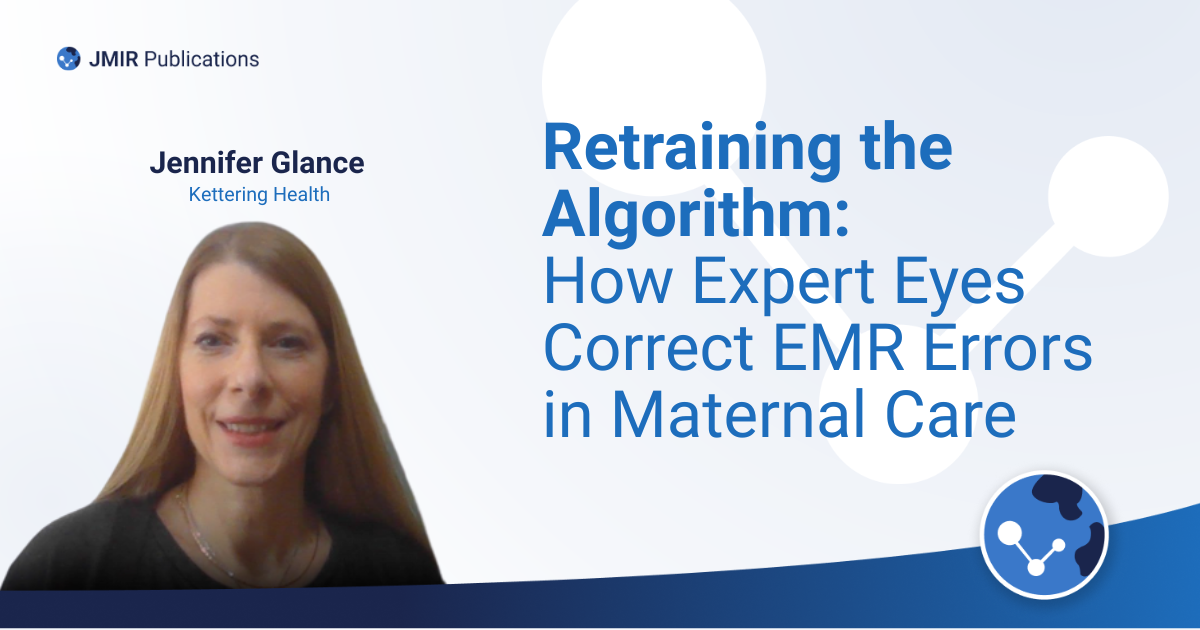
[Research News,](https://blog.jmir.org/tag/research-news) [Artificial Intelligence](https://blog.jmir.org/tag/artificial-intelligence)
### [Retraining the Algorithm: How Expert Eyes Correct EMR Errors in Maternal Care](https://blog.jmir.org/retraining-the-algorithm-how-expert-eyes-correct-emr-errors-in-maternal-care)
22 July 2026 11:41 a.m.
Postpartum hemorrhage (PPH) remains a leading cause of maternal morbidity worldwide, with blood transfusion rates hovering around 2% to 2.7%. While discussing these risks is a vital component of antenatal informed consent and shared decision-making, translating historical medical records into an accurate personal risk profile is notoriously difficult.

[Liana Ramos, Marketing Associate](https://blog.jmir.org/author/liana-ramos)
[Read More](https://blog.jmir.org/retraining-the-algorithm-how-expert-eyes-correct-emr-errors-in-maternal-care)
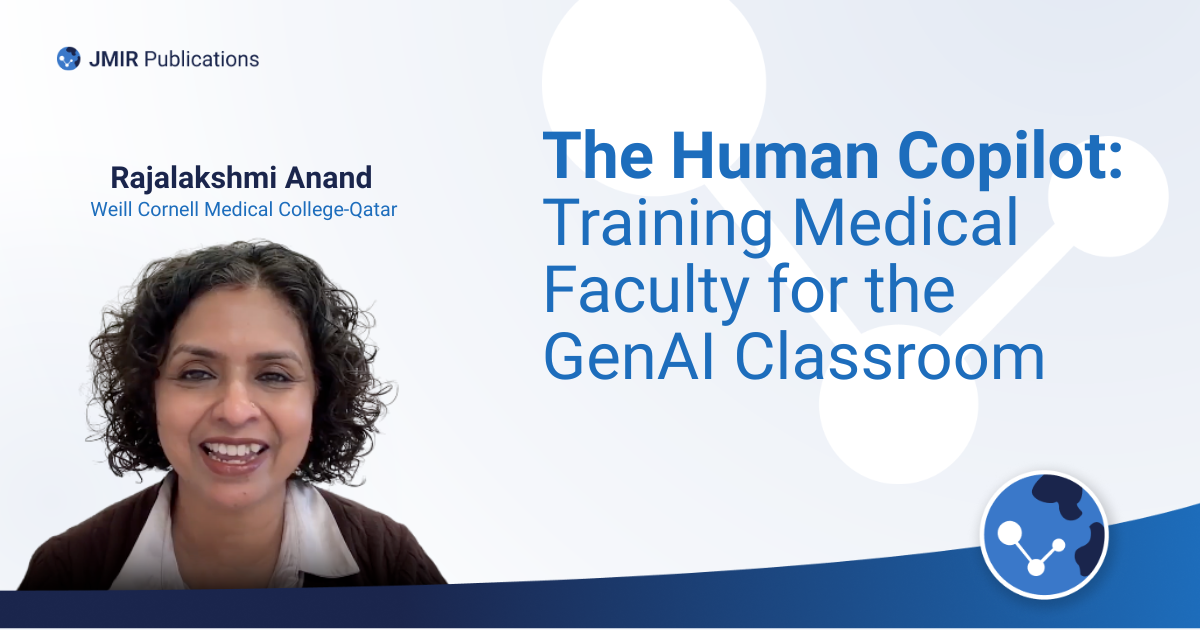
[Research News,](https://blog.jmir.org/tag/research-news) [Artificial Intelligence](https://blog.jmir.org/tag/artificial-intelligence)
### [The Human Copilot: Training Medical Faculty for the GenAI Classroom](https://blog.jmir.org/the-human-copilot-training-medical-faculty-for-the-genai-classroom)
16 July 2026 9:00 a.m.
The rapid rise of generative artificial intelligence (GenAI) has created powerful new instructional opportunities alongside major pedagogical questions. While tools like ChatGPT can enhance lesson planning, case scenario design, and assessment development, many medical educators face a steep learning curve. Without structured guidance, integrating these fast-evolving and context-sensitive tools into high-stakes, discipline-specific medical curricula carries significant risks.

[Liana Ramos, Marketing Associate](https://blog.jmir.org/author/liana-ramos)
[Read More](https://blog.jmir.org/the-human-copilot-training-medical-faculty-for-the-genai-classroom)
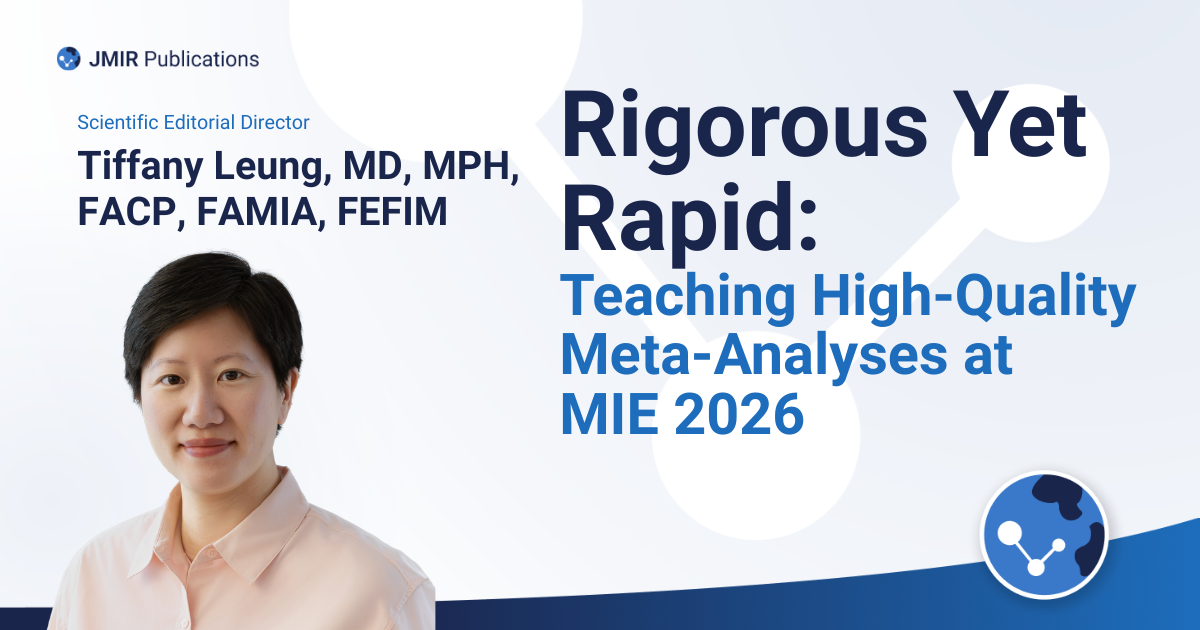
[Events,](https://blog.jmir.org/tag/events) [Early Career Researcher,](https://blog.jmir.org/tag/early-career-researcher) [Artificial Intelligence](https://blog.jmir.org/tag/artificial-intelligence)
### [Rigorous Yet Rapid: Teaching High-Quality Meta-Analyses at MIE 2026](https://blog.jmir.org/rigorous-yet-rapid-teaching-high-quality-meta-analyses-at-mie-2026)
13 July 2026 10:00 a.m.
Public health emergencies demand synthesized evidence rapidly. During COVID-19, Ebola outbreaks, and other crises, researchers face pressure to produce guidance within the first week hours, for example, to prevent further spread of infections in the community. Meanwhile, traditional systematic reviews require 6 to 18 months to complete. This temporal mismatch creates an evidence vacuum that decision-makers often fill with preliminary findings or incomplete data.

[Tiffany I. Leung, MD, MPH, FACP, FAMIA, FEFIM](https://blog.jmir.org/author/tiffany-i-leung-md-mph-facp-famia-fefim)
[Read More](https://blog.jmir.org/rigorous-yet-rapid-teaching-high-quality-meta-analyses-at-mie-2026)
[1](https://blog.jmir.org/tag/artificial-intelligence) [2](https://blog.jmir.org/tag/artificial-intelligence/page/2) [3](https://blog.jmir.org/tag/artificial-intelligence/page/3)
© 2026 JMIR Publications